

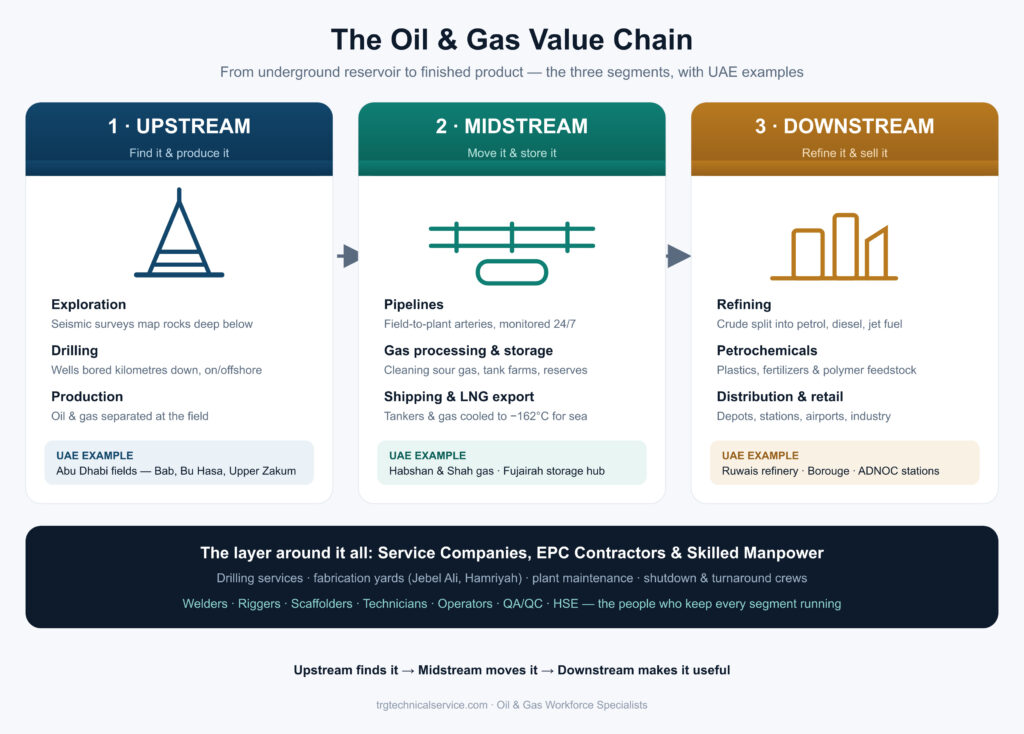
Every litre of petrol, every plastic bottle, and every gas-powered turbine begins the same way — as raw hydrocarbons buried deep underground. The journey from that underground reservoir to a finished product is called the oil and gas value chain, and it is one of the largest, most complex industrial systems on earth. The chain has three main segments — upstream, midstream, and downstream — and each one adds value to the product as it moves along. Upstream finds and extracts oil and gas. Midstream moves and stores it. Downstream refines it into the products we actually use.
This guide explains every stage in plain language, shows how the chain works right here in the UAE — home to ADNOC and one of the world’s most complete national value chains — and looks at something most guides skip: the thousands of jobs and skilled trades each stage creates.
What Is the Oil and Gas Value Chain?
A value chain is simply the series of steps that turn a raw material into a finished product, with each step adding value. Crude oil sitting two kilometres underground is worth little to anyone — it cannot be burned in a car engine or turned into plastic. Its value grows at every stage: when it is found, when it is extracted, when it is transported to a refinery, and finally when it is refined into petrol, diesel, jet fuel, or petrochemicals.
The industry splits this journey into three segments, and the names come from the image of a river. Upstream is where the resource begins (the source of the river), downstream is where it reaches the end user (the mouth of the river), and midstream is everything in between. The segments are deeply connected — a delay in upstream production is felt at petrol stations months later, and weak downstream demand pushes back on upstream investment. Understanding all three together is what understanding the industry really means.
Upstream — Finding and Producing Oil and Gas
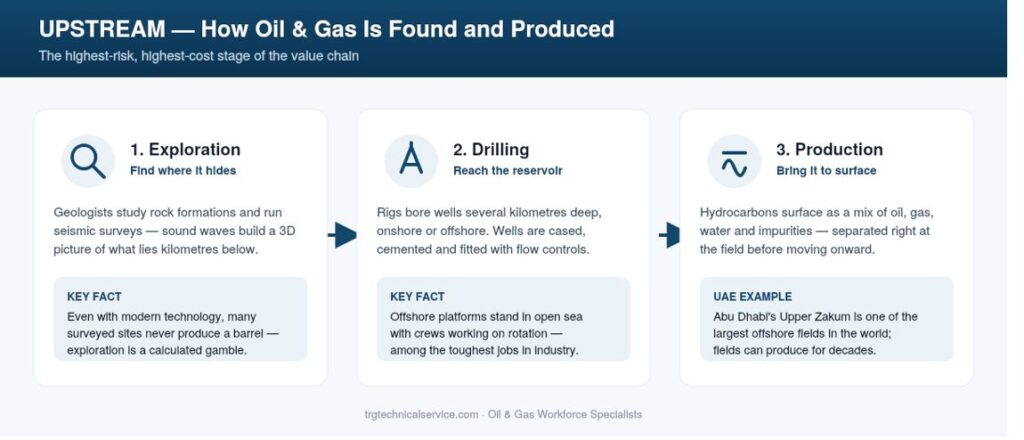
Upstream is the beginning of everything, and it is also the most expensive and highest-risk part of the chain. It covers three big activities.
Exploration. Before anyone drills, geologists must find where hydrocarbons might be trapped. They study rock formations, run seismic surveys — sending sound waves into the ground and reading the echoes to build a 3D picture of what lies below — and analyse the data to identify promising reservoirs. Even with today’s technology, exploration is a calculated gamble: many surveyed sites never produce a barrel.
Drilling. Once a promising site is found, drilling rigs bore wells that can reach several kilometres deep, onshore or offshore. The well is then “completed” — lined with steel casing, cemented, and fitted with equipment that controls the flow. Offshore drilling adds another level of difficulty, with platforms standing in open sea and crews working on rotation.
Production. When the well flows, production begins. Hydrocarbons come to the surface as a mix of crude oil, natural gas, water, and impurities, so early processing happens right at the field — separating oil from gas and water before anything moves onward. Production can run for decades, which is why fields need constant maintenance, inspection, and upgrading throughout their life.
Upstream in the UAE: Almost all of the country’s production is in Abu Dhabi, where ADNOC operates giant onshore fields such as Bab and Bu Hasa and offshore fields such as Upper Zakum — one of the largest offshore fields in the world. This is where the UAE’s value chain begins.
Midstream — Moving and Storing the Product
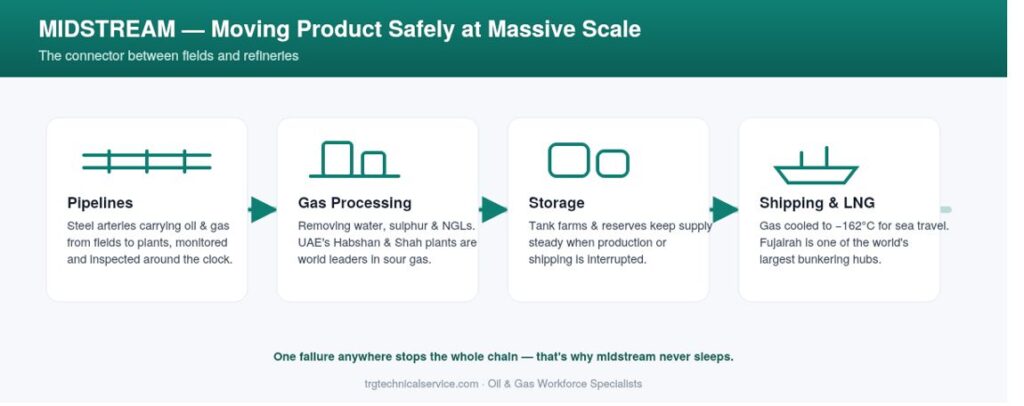
If upstream is about getting hydrocarbons out of the ground, midstream is about getting them to the places that can use them — safely, in huge volumes, without interruption. It covers four main activities.
Pipelines
The arteries of the industry. Networks of steel pipelines carry crude oil and natural gas from fields to processing plants, refineries, and export terminals. Pipelines need continuous monitoring, inspection, and maintenance, because a single failure can stop the whole chain.
Gas processing
Natural gas straight from the well contains water, sulphur compounds, and heavier liquids. Gas processing plants clean it and separate valuable natural gas liquids (NGLs) before the gas moves on. Sour gas — gas with high sulphur content — needs special treatment, something the UAE knows well through the massive sour gas plants at Habshan and Shah.
Storage
Oil and gas do not move from well to consumer in real time, so storage sits at every junction of the chain — tank farms at terminals, underground gas storage, and strategic reserves. Storage is what keeps supply steady when production or shipping is interrupted.
Shipping and export
For a global exporter like the UAE, midstream ends at the water. Crude oil is loaded onto tankers at export terminals, and natural gas is cooled to minus 162 degrees Celsius to become LNG (liquefied natural gas) so it can travel by ship. The UAE’s key export points include Jebel Dhanna, Das Island, and Fujairah — which has grown into one of the world’s largest bunkering and oil-storage hubs, strategically placed outside the Strait of Hormuz.
Downstream — Refining and Reaching the Customer
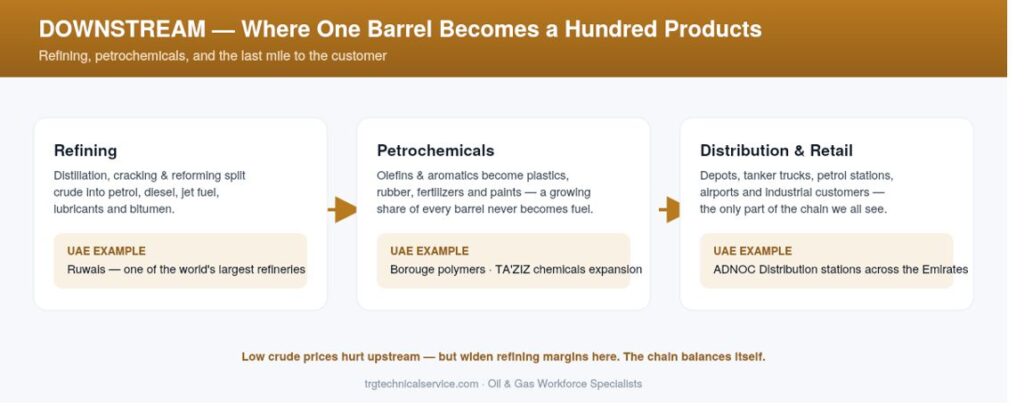
Downstream is where hydrocarbons finally become the products people and industries buy. It has three main parts.
Refining
A refinery is a giant chemical factory that separates crude oil into useful fractions — petrol, diesel, jet fuel, kerosene, lubricants, and bitumen — using heat, pressure, and catalysts. Processes such as distillation, cracking (breaking large molecules into smaller ones), and reforming let refiners adjust their output to what the market needs. The UAE’s refining heart is Ruwais in Abu Dhabi, one of the largest refinery complexes in the world.
Petrochemicals
A growing share of every barrel never becomes fuel at all — it becomes raw material for industry. Petrochemical plants convert refinery and gas products into olefins and aromatics, the building blocks of plastics, synthetic rubber, fertilizers, paints, and thousands of everyday products. In the UAE, the Borouge complex at Ruwais turns gas-based feedstock into polymers exported worldwide, and the TA’ZIZ project is expanding this chemicals push further.
Distribution and retail
The last step is the one everyone sees: fuel moving by pipeline and tanker truck to storage depots, then to petrol stations, airports, and industrial customers. Marketing, trading, and retail networks — like ADNOC Distribution’s petrol stations across the Emirates — are the final link between an underground reservoir and a customer’s fuel tank.
The Hidden Fourth Segment: Service Companies and EPC Contractors
Textbooks describe three segments, but anyone who works in the industry knows there is a fourth layer wrapped around all of them: the service and contracting ecosystem. Oilfield service companies run the seismic surveys, drill the wells, and maintain the equipment. EPC contractors (engineering, procurement, and construction) build the plants, pipelines, and platforms. Fabrication yards — like those in Jebel Ali and Hamriyah here in the UAE — build the modules and structures those projects need. Maintenance contractors keep plants running and handle the huge shutdown and turnaround campaigns that refineries and gas plants schedule every few years.
This layer matters because it is where most of the industry’s people actually work. The operator may own the field, but the welders, riggers, scaffolders, technicians, and engineers on site usually work for service companies and contractors — which is exactly why manpower is one of the industry’s most critical supply lines.
The Oil and Gas Value Chain in the UAE — A Complete National Chain
Few countries contain the entire value chain inside their own borders the way the UAE does, which makes it a perfect real-world example.
It starts upstream in Abu Dhabi’s onshore and offshore fields. Midstream, the product moves through pipelines to gas processing at Habshan and Shah, into storage, and out through export terminals at Jebel Dhanna and Das Island — with Fujairah handling storage and bunkering on the Indian Ocean side. Downstream, Ruwais refines and transforms it, Borouge and TA’ZIZ push it into petrochemicals, and ADNOC Distribution retails it across the country. Around all of this, Dubai’s Jebel Ali and Sharjah’s Hamriyah Free Zone host the fabrication yards and oilfield-service companies that build and maintain the whole system, while Sharjah also produces its own gas through SNOC.
For anyone learning the industry — student, engineer, investor, or jobseeker — the UAE is the value chain in miniature: every segment, every job type, inside one country.
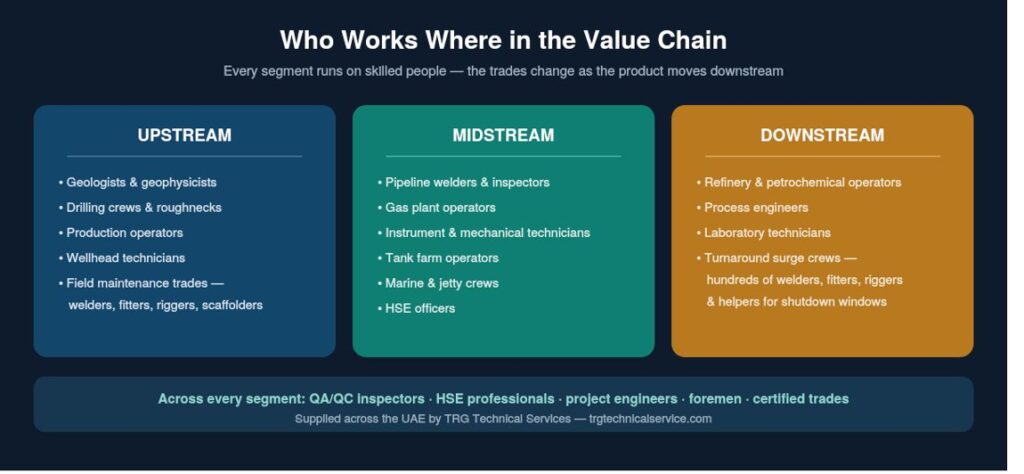
Jobs Across the Value Chain — Who Works Where
Every segment of the chain runs on skilled people, and the skills change as the product moves downstream.
Upstream jobs centre on geoscience and heavy field work: geologists and geophysicists, drilling crews, roughnecks and derrickmen, production operators, wellhead technicians, and the maintenance trades — welders, fitters, riggers, and scaffolders — that keep field facilities running.
Midstream jobs centre on moving product safely: pipeline welders and inspectors, gas plant operators, instrument and mechanical technicians, tank farm operators, marine and jetty crews, and HSE officers watching over it all.
Downstream jobs centre on process operations: refinery and petrochemical plant operators, process engineers, laboratory technicians, and — during shutdowns and turnarounds — surge crews of hundreds of welders, fitters, riggers, and helpers mobilized for a few intense weeks.
Across every segment, the service layer employs QA/QC inspectors, HSE professionals, project engineers, foremen, and the certified trades that projects cannot start without. In the UAE, demand for these roles rises and falls with project cycles, maintenance seasons, and turnaround schedules — which is why energy companies here rely on specialist manpower partners to keep crews at full strength. TRG Technical Services supplies exactly this workforce across the chain, from certified 6G welders for Ruwais-scale projects to full turnaround crews — you can read how on our oil and gas recruitment agency in UAE page, or see how supplied crews work on our oil and gas manpower supply in UAE page.
Frequently Asked Questions
What are the three stages of the oil and gas value chain?
Upstream (exploration, drilling, and production), midstream (transportation, processing, and storage), and downstream (refining, petrochemicals, and distribution to customers).
What is the difference between upstream and downstream?
Upstream gets oil and gas out of the ground; downstream turns it into finished products like petrol, diesel, and plastics. Midstream connects the two by moving and storing the product.
Is LNG upstream, midstream, or downstream?
LNG (liquefying natural gas for shipping) is generally classified as midstream, because it is a form of transportation and storage rather than production or refining.
Which part of the value chain is most profitable?
It changes with market conditions. High crude prices favour upstream; low crude prices widen downstream refining margins. This is why integrated companies operate across all three segments.
What does the oil and gas value chain look like in the UAE?
It is one of the world’s most complete national chains: upstream fields in Abu Dhabi, gas processing at Habshan and Shah, export terminals at Jebel Dhanna and Fujairah, refining and petrochemicals at Ruwais, and retail through ADNOC Distribution — supported by fabrication and service hubs in Jebel Ali and Hamriyah.
Which jobs exist across the value chain?
Everything from geologists and drilling crews (upstream) to pipeline welders and plant operators (midstream) to refinery operators and turnaround crews (downstream) — plus the engineers, inspectors, and certified trades that the service layer supplies to all three.


